Introduction: Reclaim Rubber; Rethinking Waste in a Resource-Constrained World
Every year, more than one billion tyres reach the end of their life worldwide. These end-of-life tyres (ELTs) have posed a massive environmental challenge; they are clogging landfills, creating fire hazards, and contributing to long-term soil and air pollution. Yet, in today’s sustainability-driven industrial landscape, this challenge is rapidly increasing.
By using discarded tyres and converting them into high-value industrial raw material, reclaim rubber plays an important role in driving the circular economy in the rubber industry.
This blog explores the complete journey of end-of-life tyres, the environmental and economic importance of reclaimed rubber, and how circular manufacturing is redefining the future of rubber-based products across industries.
To support these transformations with consistent quality and performance, manufacturers can explore a wide range of reclaim-rubber grades developed for tyre, industrial, footwear, and engineering applications through Swani Rubber Industries’ product portfolio.
Understanding End-of-Life Tyres (ELTs)
Tyres are engineered for strength, durability, and resistance to harsh conditions. As these properties make them an essential part for transportation and industrial use, they also make tyres extremely difficult to decompose.
When these end-of-life tyres are not recycled properly, they can:
- Occupy massive landfill space
- Traps rainwater and becomes a breeding ground for disease
- Release toxic emissions if burned
- Leach harmful chemicals into soil and groundwater
For many years, industries struggled to manage this growing waste stream, but the solution was not incineration or dumping; it was recovery and reuse through reclaim rubber manufacturing.
What Is Reclaim Rubber?
Reclaim rubber is a processed form of rubber obtained from end-of-life tyres and industrial rubber waste through controlled mechanical, thermal, and chemical methods. Reclaim rubber retains valuable polymer properties while offering improved processability and cost efficiency.
There are key types of commonly used rubbers in modern manufacturing:
- Natural Reclaim Rubber
- Whole Tyre Reclaim (WTR)
- Butyl Reclaim Rubber
- Super Fine Reclaim Rubber
- High Tensile Reclaim Grades
These materials are widely used in tyre production, conveyor belts, footwear, hoses, mats, molded rubber goods, and numerous industrial applications.
As a responsible manufacturer, Swani Rubber Industries (SRI) actively contributes to circular manufacturing by converting end-of-life tyres into high-quality reclaim rubber that supports both performance-driven and sustainability-focused industries.
The Circular Economy Explained in the Context of Rubber
The circular economy is a system that focuses on eliminating waste, keeping resources in continuous use, and regenerating natural systems. Unlike the traditional system “take–make–dispose” model, the circular approach builds value through reduction, reuse, recycling, and regeneration.
In the rubber industry, this means:
- Used tyres are collected instead of being discarded
- They are processed into reclaimed rubber
- Reclaimed rubber replaces a portion of virgin raw materials
- New products are manufactured
- The cycle continues again at the product’s end of life
The Journey: From End-of-Life Tyres to Reclaimed Rubber
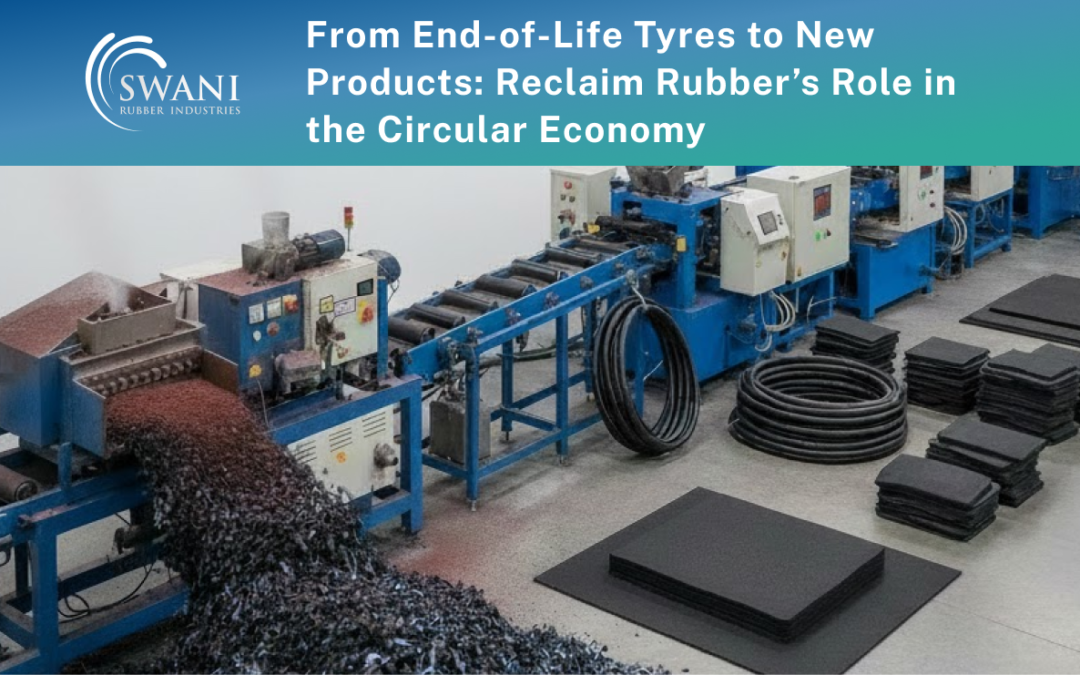
The transformation from waste tyre to premium reclaimed rubber involves multiple technical steps. Let’s discuss those stages:
1. Collection and Sorting – Discarded tyres are collected from transport hubs, repair centers, municipal waste streams, and industrial users. They are sorted based on size, composition, and condition.
2. Shredding and Size Reduction – Tyres are mechanically cut into chips and granules. Steel and textile reinforcements are removed for separate recycling.
3. Devulcanization and Reclamation – Vulcanized rubber is processed using heat, pressure, and proprietary techniques to break sulphur cross-links while preserving polymer chains.
4. Refining and Quality Control – The reclaimed rubber is filtered, refined, and tested for Tensile strength, elongation, Mooney viscosity, Ash content, and Rubber hydrocarbon content
5. Sheet Formation and Packaging – Final reclaim rubber sheets are processed, packed, and shipped to manufacturers worldwide.
This conversion transforms rubber waste into a consistent, performance-driven industrial input.
Why Reclaim Rubber Is Central to Sustainable Manufacturing
1. Massive Environmental Impact Reduction: Using reclaimed rubber instead of virgin rubber significantly reduces:
- Carbon emissions
- Crude oil dependency
- Energy consumption
- Greenhouse gas output
- Landfill burden
Each ton of reclaimed rubber saves multiple tons of natural resources and fossil-fuel-based materials.
2. Lower Carbon Footprint: The production of reclaimed rubber requires less energy compared to producing virgin rubber. This helps manufacturers to meet the global ESG targets and carbon neutrality goals.
3. Conservation of Natural Resources: Natural rubber relies on rubber tree plantations, deforestation, and climate-sensitive agriculture. By substituting reclaimed rubber, industries protect forests and biodiversity.
Economic Advantages of Reclaimed Rubber in Circular Production
In real manufacturing environments, this balance between sustainability and cost is exactly what procurement and production teams look for.
1. Cost Efficiency: Reclaimed rubber is more affordable than virgin rubber, helping manufacturers control raw material volatility.
2. Improved Processing Performance: Reclaim rubber offers faster mixing, lower energy consumption, enhanced flow properties, and reduced compounding time.
3. Stable Supply Chain: As natural rubber depends on climate and geography, reclaimed rubber provides a more resilient and location-independent supply.
The Role of Reclaimed Rubber in ESG and SDG Goals
Reclaim rubber directly contributes to multiple United Nations Sustainable Development Goals (SDGs):
- SDG 9 – Industry, Innovation & Infrastructure
- SDG 11 – Sustainable Cities
- SDG 12 – Responsible Consumption & Production
- SDG 13 – Climate Action
- SDG 15 – Life on Land
For corporations under ESG pressure, reclaimed rubber sourcing strengthens sustainability reporting and stakeholder trust.
To understand how responsible reclaim rubber manufacturing translates into real-world environmental and social performance, Swani Rubber Industries outlines its sustainability initiatives, compliance framework, and ESG commitments in detail through its dedicated ESG portal.
Challenges in Reclaim Rubber Manufacturing
Like any industrial transformation, reclaiming rubber has many key challenges:
1. Odour and Emission Control: Modern reclaim plants now use advanced filtration and emission control systems.
2. Quality Consistency: Automated testing, tighter formulation control, and grade specialization ensure uniform performance.
3. Buyer Awareness: Older myths about reclaimed rubber quality are being replaced by data-driven performance proofs and industry certifications.
Today, reclaimed rubber stands as a reliable engineering material, not a low-grade alternative.
Why Reclaim Rubber Is No Longer Optional; It’s Strategic
Manufacturers across the globe are no longer asking whether to use reclaimed rubber. They are asking:
- How much can we replace?
- Which grade suits our formulation?
- How do we certify our circular sourcing?
- How do we communicate sustainability to global buyers?
Reclaimed rubber is now a strategic raw material, not a secondary filler.
Conclusion
The journey from end-of-life tyres to new products is no longer waste management, but it is resource engineering. Reclaim Rubber transforms industrial responsibility into measurable economic and environmental advantage. At Swani Rubber Industries, reclaim rubber transforms sustainability commitments into measurable environmental value for the industries we serve.
By keeping rubber in continuous motion instead of allowing it to accumulate in landfills, reclaim rubber provides circular production, drives carbon reduction, supports cost optimization, strengthens ESG compliance, and delivers a lasting global sustainability impact.
In this evolving world of advanced manufacturing, reclaimed rubber represents how innovation, responsibility, and performance can coexist. The circular economy does not begin with recycling, but it begins with intelligent material choices, and the end-of-life tyre transformation is one of those choices.