
ESG Practices in Reclaimed Rubber Manufacturing: How Sustainability Works
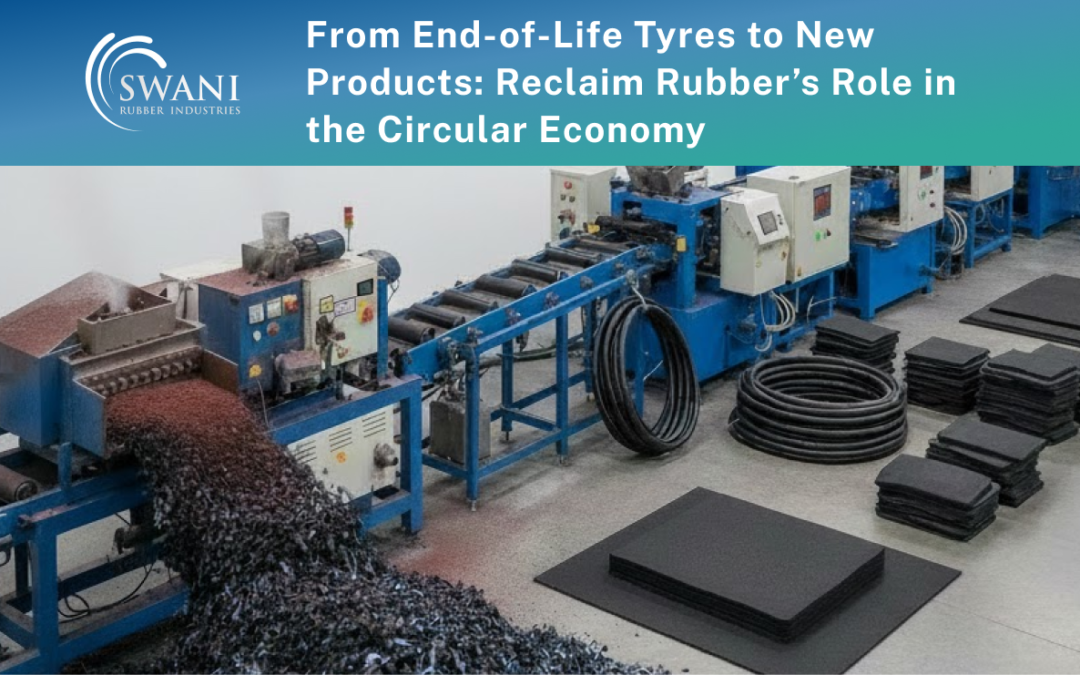
Reclaimed rubber sits at the intersection of two big realities: the world’s growing waste challenge and industry’s need for reliable, cost-effective raw materials. Every year, around one billion end-of-life tyres (ELTs) reach the end of their usable life globally, an enormous waste stream that can strain landfills and raise environmental and safety risks if not managed responsibly.
This is where reclaimed rubber manufacturing moves from being an option to an essential part of industrial sustainability. But not all recycling is equal. The real difference is how reclaimed rubber is produced—the controls, compliance, worker protections, emissions management, and the traceability of inputs.
That “how” is what ESG practices are about.
In this blog, we’ll break down how ESG practices in reclaimed rubber manufacturing strengthen real-world sustainability outcomes, what is globally evaluated, and how ESG translates into measurable improvements across environmental performance, workplace safety, governance discipline, and supply-chain credibility. Also, we’ll connect these practices to the broader rubber value chain—because reclaimed rubber sustainability is not only a manufacturer’s responsibility, but it’s also increasingly a buyer’s requirement.
ESG in reclaimed rubber: what it really means
ESG stands for Environmental, Social, and Governance. In practical manufacturing terms, it answers three questions:
- Environmental: How efficiently and responsibly do you use energy, water, and materials, and what do you do to reduce waste and emissions?
- Social: How do you protect workers and contribute to safe, fair operations for people involved in the value chain?
- Governance: How do you ensure consistent decision-making, compliance, traceability, and ethical conduct?
In reclaimed rubber, ESG matters because manufacturing involves multiple steps—sorting, shredding, devulcanisation/reclamation, refining, testing, and dispatch. Where quality, emissions, safety, and compliance all depend on process discipline.
Why ESG is becoming non-negotiable for reclaimed rubber buyers
Global OEMs and tier suppliers increasingly evaluate suppliers using ESG lenses because:
- Regulatory pressure is increasing, especially in Europe and sustainability-focused markets
- Chemical compliance and transparency matter
- ESG reporting has moved into procurement
For example, REACH (Registration, Evaluation, Authorisation, and Restriction of Chemicals) is a major EU regulation designed to improve protection of human health and the environment from risks posed by chemicals.
In rubber supply chains, REACH-related requirements can influence documentation, material declarations, and expectations around chemical safety and responsible sourcing.
This is why many buyers now look for credible suppliers—ISO frameworks, documented controls, and audit-ready processes.
Environmental: how ESG drives sustainability in reclaimed rubber production
1) Energy efficiency and renewables
Reclaimed rubber processes can be energy-intensive depending on technology, refining time, and scale. Research shows that process improvements can reduce energy use in parts of reclaimed rubber production.
ESG-aligned manufacturers treat energy as a controlled input:
- tracking electricity and thermal energy use per batch or per tonne,
- improving equipment efficiency,
- and investing in renewables where feasible, like wind or solar integration.
This is how eco-friendly reclaimed rubber becomes a measurable manufacturing outcome.
2) Waste reduction and circularity
Reclaimed rubber is already circular by nature, but ESG raises the bar:
- reducing yield losses in processing,
- recovering materials responsibly (steel/textile separation, residue handling),
- optimising packaging to reduce waste, like reusable packaging systems.
The result is stronger reclaimed rubber sustainability performance, not only in output but across the full operating footprint.
3) Environmental management systems
Many industrial manufacturers use ISO standards to turn intent into systems. ISO 14001 provides a framework for an environmental management system (EMS) focused on continual improvement and proactive control of environmental impacts.
In reclaimed rubber manufacturing, an ISO 14001-style EMS typically supports:
- compliance tracking (permits, regulations),
- structured monitoring of environmental aspects,
- waste management and emergency response planning,
- continuous improvement projects tied to measurable metrics.
Social: the “S” in ESG is not optional in heavy manufacturing
1) Worker safety is a production issue, not a PR issue
Rubber processing facilities involve machinery, heat, moving materials, and operational risk. Social performance starts with protecting workers through structured safety management, training, and incident prevention.
ISO 45001 is an international standard for occupational health and safety management systems, providing a framework to manage risks and improve OH&S performance.
In practical terms, ESG-aligned safety looks like:
- documented safety procedures,
- emergency preparedness drills,
- proper PPE standards,
- near-miss reporting and corrective actions,
- and leadership accountability.
This matters for sustainability because injuries and unsafe conditions are not “side issues”—they’re operational failures.
2) Fair work practices and capability building
Buyers increasingly ask for evidence of fair labour practices, training, and workforce development. These are not just ethical expectations; they reduce operational disruptions and improve consistency in production quality over time.
Governance: the foundation of a trustworthy reclaimed rubber supply
Governance is where many sustainability claims either stand up or fall apart.
1) Quality systems: ISO 9001 and consistency of supply
ISO 9001 is a globally recognised quality management standard aimed at consistently meeting customer and regulatory requirements through a structured QMS and continual improvement.
For reclaimed rubber, governance-linked quality means:
- batch-to-batch consistency,
- defined testing protocols (physical/chemical),
- corrective action processes,
- and traceable documentation.
Without governance discipline, even “green” products struggle to earn long-term buyer trust.
2) Ethics, transparency, and anti-corruption
Many global buyers expect clear commitments on ethics and anti-corruption as part of supplier onboarding, especially for long-term contracts.
The UN Global Compact Ten Principles cover fundamental responsibilities across human rights, labour, environment, and anti-corruption.
Alignment with these principles can help guide a structured approach to responsible business conduct.
3) ESG ratings and third-party evaluation
Third-party sustainability ratings are increasingly used for supplier risk screening. EcoVadis, for example, evaluates performance across four themes: environment, labour & human rights, ethics, and sustainable procurement.
For reclaimed rubber suppliers, these frameworks encourage:
- documentation readiness,
- consistent policy-to-practice execution,
- and measurable improvement over time.
How ESG Practices Improve the Environmental Impact of Recycled Rubber
“Environmental impact” is often treated as a vague phrase. ESG helps make it specific.
In reclaimed rubber manufacturing, better ESG typically improves impact through:
- diverting tyres from landfill or unsafe disposal
- reducing demand for virgin raw materials,
- lowering energy use per tonne through efficiency improvements,
- and reducing compliance risks like chemical safety, audit-readiness, and documentation.
This is why many procurement teams now ask not only, “Do you make reclaimed rubber?” but also
- “How traceable are your inputs?”
- “What standards back your processes?”
- “What is your compliance position for export markets?”
- “How do you manage worker safety and environmental controls?”
Those questions sit at the heart of ESG strategies for rubber industry supply chains.
Where Swani Rubber Industries fits in this ESG reality
At Swani Rubber Industries, credibility is built by the fact that sustainability is not a statement but an operational reality. In natural reclaim rubber manufacturing, this means embedding ESG principles directly into how materials are sourced, processed, tested, and supplied to global customers.
At Swani, ESG alignment begins with a clear vision and mission that are closely tied to manufacturing discipline and compliance-led operations.
Our Vision
To lead the global rubber industry by promoting sustainable and eco-friendly natural reclaim rubber, while working responsibly toward a greener and more prosperous future for generations to come.
Our Mission
To actively contribute to the reclaim rubber industry through disciplined manufacturing, environmental responsibility, and ethical operations—delivering reliable natural reclaim rubber solutions that meet performance expectations and create positive impact for the environment.
These commitments are reinforced through recognised global frameworks, including ISO 9001, ISO 14001, and ISO 45001, along with alignment to the UN Global Compact and EU REACH compliance. Together, these standards assure global buyers that Swani’s natural reclaim rubber is manufactured under controlled, transparent, and responsible ESG practices suitable for international markets.
Common challenges and how ESG helps solve them
Even strong reclaimed rubber producers face challenges such as
- Consistency concerns: ESG-linked governance strengthens testing discipline and traceability.
- Buyer skepticism: Third-party frameworks and compliance alignment reduce uncertainty (REACH awareness, EcoVadis-style evaluations).
- Operational risk: OH&S systems reduce incident disruptions and strengthen reliability.
- Regulatory complexity: Environmental management systems improve legal compliance management and continuous improvement cycles.
Conclusion
Reclaimed rubber already plays an important role in circular manufacturing by transforming ELTs into usable industrial inputs. But the next chapter is about credibility: evidence, systems, and verifiable practices.
That’s why ESG practices in reclaimed rubber manufacturing matter as they help ensure that sustainability is not a claim on a brochure but a repeatable outcome supported by:
- environmental controls,
- worker protection,
- governance discipline,
- and global compliance readiness.
In a world where around a billion tyres reach end-of-life each year, the industry needs more than recycling, but it needs responsible industrial systems that keep materials in use, reduce risk, and strengthen trust across the supply chain.
And for manufacturers and buyers alike, that’s where ESG becomes strategic. At Swani Rubber Industries, we consistently supply eco-friendly natural reclaim rubber that meets global expectations for scale, auditability, and reliability.